
Your Next Adventure Starts Here
An 8-day ascent to the roof of Africa. Starting at Lemosho on the Western side and traversing across the most spectacular parts of the mountain. It joins the Machame route above Shira Camp on day 4 and then from Barafu camp ascends to the summit via Stella Point. Descent is via the Mweka route.
HIGHLIGHTS
Kilimanjaro! afromontane forest, Shira plateau, glacial valleys and alpine desert, views of Mawenzi, ascent of Kibo and possible views of Kibo caldera and ash pit. Glaciers and the roof of Africa.
In Brief
Hike Distance – 37miles/64 km
Vertical Gain – 15,441ft/4706m
Drop – 16,070ft/4898m
Trekking Time – 52 hours
In Brief Highlights
- Remote western trailhead
- Expansive Shira Plateau views
- High-altitude Lava Tower climb
- Scramble the Barranco Wall
- Smaller summit camp advantage
- Experience Arusha National Park located at the base of Mt. Meru
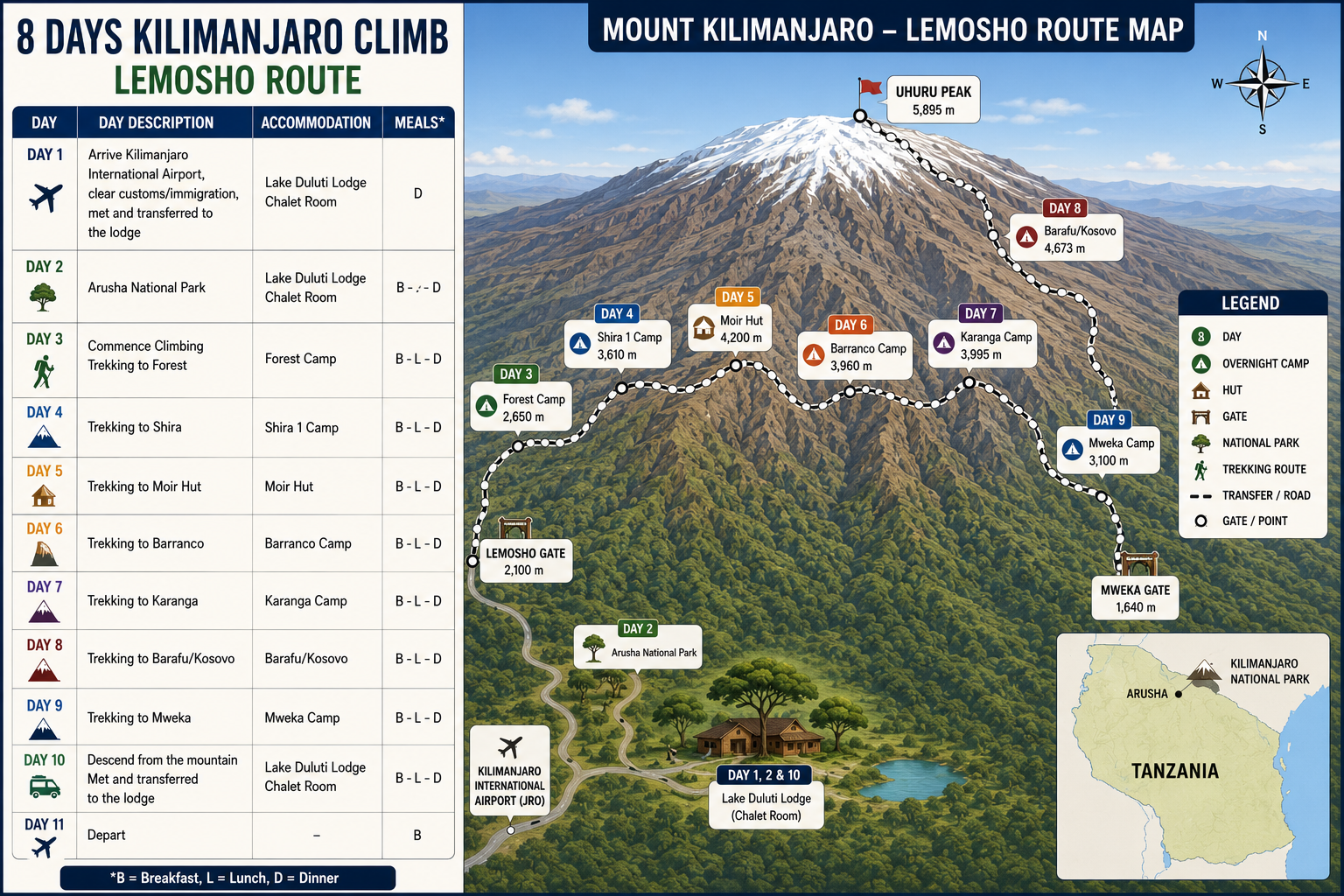
Tour Itinerary
Arrive Kilimanjaro International airport, clearing customs/immigration, met by Mimi 2 Africa Luxury Travel representative and transferred to Lake Duluti Lodge for check -in, freshen up, dinner and overnight.
Twenty minutes from Arusha in northern Tanzania lies the scenic crater lake, Duluti, and atop its steep-sided, forested shores, is Lake Duluti Lodge. The lodge is made up of 18 contemporary chalets on a small working coffee farm. All have luxurious bathrooms and decks from which to max out on views across the lake and towards impressive Mount Meru. Furnishings lend a glorious, cozy home from home feel with plump cushions and thick rugs on wooden floors, and the food is divine: all farm fresh and home cooked.
Lake Duluti is almost two thirds of a mile (one kilometer) across – and the same deep. The forested walls of the crater, up to 660 feet (200 meters) high, are home to a host of birds – herons, fish eagles, ospreys and kingfishers.
There’s plenty to do – you can go canoeing or bird watching. The walk around the lake is a must, the path shaded all day with a tangle of green. Or indulge in a coffee tour so you know where your brew begun.
Lake Duluti Lodge
Chalet Room
After breakfast you will be picked up from the hotel reception and drive to Arusha National Park for game viewing drive with picnic lunch.
On arrival at the park, check-in and begin the game drives through the park trails. The game drive gives you an opportunity to see a large part of the park including places like the Momella lakes and Ngurdoto Crater.
Arusha National Park is situated in the northern region of Tanzania. It lies in the North-eastern region of the town of Arusha. Don’t get fooled by the fact that Arusha National Park is small. It has an extensive habitat that’s home to some wonderful Tanzania Wildlife.
The scenic landscapes are made up of the peaks of Mount Meru, the Ngurdoto Crater, and the lush grasslands of montane forests. Even though Arusha National Park doesn’t have as much wildlife compared to other National Parks in Tanzania. It more than makes up for it based on breathtaking landscapes, hiking opportunities on Mount Meru, and amazing outdoor activities.
After the game drive into the park, return to the hotel in time to freshen up before dinner.
Lake Duluti Lodge
Chalet Room
Enjoy breakfast at the lodge
08:00 After breakfast, you will meet your Mountain guide at the lodge lobby for a short climbing briefing, picked up and drive to the Kilimanjaro National Park Londorossi Gate, register/ complete formalities then set out in vehicles to the starting point of the Lemosho trail to commence the climb. Here you meet the rest of your crew and set of at a leisurely pace into Afromontane Forest. Lunch is taken on trail and camp is reached midafternoon.
Overnight Forest Camp
Londorossi Gate to Forest Camp
- Elevation (ft): 7,800ft to 9,500ft
- Distance: 6 km
- Hiking Time:3-4 hours
- Habitat: Rain Forest
From the forested slopes of Lemosho you ascend through Podocarpus and Juniper Forest and break out of the forest on to the heath zone and the Shira Plateau. Lunch is taken on trail and you arrive in camp midafternoon. Overnight Shira 1 Camp. Alt 3,560m, 11,680ft (full board).
Overnight at Shira Camp
Forest Camp to Shira Camp
- Elevation (ft):to 11,500ft
- Distance: 8 km
- Hiking Time 5-6 hours
- Habitat: Moorland
Crossing the Shira plateau can be one of the most scenic parts of the trip and this morning we hike for around 3-4 hours to the lunch point. After lunch we ascend to Moir camp (Alt 4,100m, 13,451ft) arriving in the midafternoon. For those with the energy a hike in the late afternoon is possible.
Overnight at Moir Camp
Shira Camp 1 to Shira 2 to Moir Hut
•Elevation (ft): 11,500ft to 13,800 ft
•Distance: 14 km
•Hiking Time: 5-7 hours
•Habitat: Moorland
From Moir we traverse across the slopes of Kibo. Here relatively little flora or fauna can survive the extreme temperature ranges and conditions that typify this zone. Lunch is normally taken close to Lava Tower (Alt 4,600m, 15,092ft) and for those that feel very strong there is an optional ascent of Lava Tower before descending down to Barranco camp (Alt 3,910m, 12,828ft) in the afternoon.
Overnight at Barranco Camp
Moir Hut to Lava Tower to Barranco Camp
- Elevation (ft): 13,800ft to 13,000ft
- Distance: 7 km
- Hiking Time: 4-6 hours
An early start is recommended to hike the Barranco wall. After about 2 hours you reach the top and then hike over glacial valleys to Karanga camp (Alt 4,100m, 13451ft), Sunsets here are particularly spectacular with views of the southern glacial valleys and ice fields towering 1000 meters (over 3000 feet) above you.
Overnight at Karanga Camp
Barranco Camp to Karanga Camp
- Elevation (ft): 13,000ft to 13,100ft
- Distance: 5km
- Hiking Time: 4-5 hours
- Habitat: Alpine Desert
Today is another half day ascending to Barafu camp (Alt 4,600m, 15,092ft). Once again lunch is taken in camp allowing plenty of time to relax before the summit bid. Desolate alpine desert and at times strong winds rip over this camp and yet in the evening splendid views of Mawenzi volcano are the norm.
Overnight at Barafu Camp
Karanga Camp to Barafu Camp
- Elevation (ft): 13,100ft to 15,300ft
- Distance: 4 km
- Hiking Time: 4-5 hours
- Habitat: Alpine Desert
Most people depart just before midnight for the final summit bid. Patience and persistence is the name of game to reach the summit and by dawn as the first rays of light start to appear, most arrive near the rim. Ascending via Stella Point (Alt 5,750m, 18,865ft) affords a relatively short final section to Uhuru peak (Alt 5,895m, 19,341ft) the Roof of Africa. What goes up must come down and your goal today is to reach Mweka camp (Alt 3,100m, 10,171ft).
Overnight at Mweka Camp
Barafu Camp to Summit to Mweka Hut
- Elevation (ft): 15,300ft to 19,345ft (and down to 10,000ft)
- Distance: 5 km ascent / 12 km descent
- Hiking Time: 7-8 hours ascent / 4-6 hours descent
- Habitat: Arctic
On your last day, you hike mainly through forest, trekking downhill – a pleasant change after summit day. At Mweka Gate you pick up your well-deserved certificate before being transferred by our Mimi 2 Africa Luxury Travel driver guide to Lake Duluti Lodge. Here you will relax in the room and enjoy a hot shower and lunch
Spend the rest of the day relaxing at the lodge.
Lake Duluti, formed dramatically inside a volcanic crater, lies placidly – stunningly – in the protective shadow of Mount Meru. Thick forest curls its way around the lake, alive with the hundreds of different reptile and bird species.
Lake Duluti Lodge sits on the lake’s shores: eighteen chicly African styled chalets across the thirty-acre coffee farm it encompasses. All have private decks facing the farm, so you feel at home in this cozy corner of northern Tanzania, secluded – but still a convenient 35-minute drive from Arusha’s busy center.
Canoeing trips on the lake, hiking in the Duluti Forest, bird watching, and coffee tours can all be arranged. If you prefer to relax and catch your breath before the big adventure there are plenty of options and lots of time to do just that; lounging areas ideal for a sundowner, looking out over the lake and her magnificent, mountainous mother.
Mweka Camp to Mweka Gate
Elevation (ft): 10,000ft to 5,400ft
•Distance: 10 km
•Hiking Time: 3-4 hours
•Habitat: Rain Forest
Lake Duluti Lodge
Chalet Room
After a memorable ascent of Mount Kilimanjaro and perhaps a relaxing post-trek stay, it’s time to bid farewell to Tanzania and your lodge staff. Enjoy a leisurely morning at your lodge—perhaps engaging in some last-minute souvenir shopping or reflecting on your incredible adventure.
Check-out is typically at 11:00 AM; however, late check-out may be available for an additional charge (please inquire with us). A representative from Mimi 2 Africa Luxury Travel will then pick you up from your lodge and transfer you to Kilimanjaro International Airport (JRO) for your international departure flight.
We hope you leave with cherished memories of your Tanzanian experience and look forward to welcoming you back in the future.
- All Kilimanjaro national park fees and rescue fees
- All guides (NOLS qualified) and porters
- Transfers to/ from Kilimanjaro International Airport and to/from Kilimanjaro National Park trail heads
- All food on the mountain with services of dedicated Mimi 2 Africa Luxury Travel cook
- Filtered water while on the mountain
- All safety equipment (including portable altitude chamber)
- All camping equipment
- All communication techniques (radio, satellite phones, cell phones)
- Porterage of 2 bags per person
- Pre-nights at Lake Duluti Lodge half board basis
- International Air fares
- Items of a personal nature
- Laundry Services at Lake Duluti Lodge
- Drinks at Lake Duluti Lodge
- Gratuities to transfer drivers, guides, cooks and porters on the mountain
- Travel Insurance
- Excess baggage fees
- Departure taxes and any other applicable airport taxes
- Meals or sightseeing not included in the itinerary
- Any optional activities
- Visa for Tanzania
- Personal health insurance
Enquire for the Itinerary
Why Book With Us
Customer Satisfaction
Our commitment to exceptional service guarantees a seamless journey, with a focus on exceeding customer expectations every step.
Easy Booking
Our simple and user-friendly booking process makes planning your trip hassle-free, so you can focus on enjoying your journey.
Best Prices
Our simple and user-friendly booking process makes planning your trip hassle-free, so you can focus on enjoying your journey.
Guaranteed Departure
No matter what, your trip is guaranteed to depart as scheduled, providing you with peace of mind and reliability.
Safety First
We prioritize your safety, implementing strict health and safety protocols, ensuring a worry-free travel experience at all times.
Superior Service
Enjoy top-tier service with professional, friendly staff ready to assist, ensuring you have a smooth and enjoyable experience.
What You Need to Know Before You Go
Passport and Visa Information
In order to enter Tanzania as a citizen of the United States, you will need:
A signed, valid passport and a tourist visa*. Your passport must remain valid for at least 6 months beyond the completion of your trip.
It is also imperative that your passport has at least 2 blank visa pages available for entry and exit stamps. Additional blank pages are always a prudent precaution.
If you are not a citizen of the United States, your entry requirements may vary. Please consult your nearest diplomatic or consular office of the country or countries you will be visiting.
Tourist visas for Tanzania can be purchased either on arrival or by applying in advance through a visa processing service. While there are additional costs involved in using these services, we encourage you to obtain your visa ahead of time, as long lines can be common. The current cost for obtaining a Tanzania visa is USD $100 (subject to change without notice). Tanzania currently only issues multiple-entry visas to U.S. passport holders. For those planning on obtaining their visa upon arrival, the visa fee must be paid in cash and can be paid in U.S. currency.
Consular Information
The U.S. State Department provides Country Specific Information sheets for every country in the world, as well as Travel Alerts and Warnings. Find this information by calling 888 407 4747 or 202 501 4444 or online at travel.state.gov.
Currency
Tanzania’s unit of currency is the Tanzania Shilling.
The country has a cash-based economy. U.S. dollars are widely accepted. Major credit cards are accepted on a very limited basis, mainly only in the largest shops, hotels and lodges. ATMs are available in larger city centers like Arusha and Dar es Salaam, but less frequent in remote areas.
Exchange money only at authorized outlets such as currency exchange kiosks, banks and hotels. Only exchange what you feel you will need while visiting. Save all receipts from any currency transaction. You may be asked to produce them when you exit the country, and they are required if you intend to reconvert local currency.
We suggest travelling with some U.S. dollars to be exchanged for local currency and at least two major credit cards. Because of Tanzania’s cash-based economy, we suggest you bring enough cash in USD $ (in smaller denominations), to finance your gratuities, purchases and other incidentals.
If you have a “Chip and PIN” card, be careful to shield your number from view while entering it on a keypad; never disclose your PIN verbally. Notify your credit card company of your travel plans prior to your departure to avoid any fraud concerns.
We do not recommend traveller’s checks as they are not as widely accepted as in previous years, and are only accepted at some banks and international hotels.
Of Special Note: When travelling in Africa it is recommended that you use only U.S. currency that was printed within the last 5 years. Many merchants and service providers will not accept currency that is more than several years old. Extremely wrinkled, torn or faded bills are also generally not accepted.
Health
It is important to familiarize yourself with any potential health issues or concerns related to your destination, and so we strongly recommend consulting the Centers for Disease Control and Prevention (CDC) for up-to-date information on required and recommended vaccines and medications. Visit them online at wwwnc.cdc.gov/travel or call 800 232 4636. Plan to visit your doctor or local travel clinic at least 4-6 weeks before departure to allow time for any vaccinations to take effect or to fill any prescriptions.
Required Vaccination
A yellow fever vaccination is required to enter Tanzania only if you are arriving from or have transited through a yellow fever endemic area in South America or Africa – including the countries of East Africa such as Kenya and Uganda. This means that if you are arriving into Tanzania after visiting Kenya for example, you may be asked to show proof of yellow fever vaccination. The CDC provides a current list of all affected countries. If vaccination for yellow fever is necessary, you must carry an International Certificate of Vaccination provided by your physician; without it, you may be denied entry. If your physician advises against receiving the vaccination because of your personal medical history, he or she can provide you with the necessary documentation for the country(ies) that you are visiting.
Additional Note: Because of the high elevations you will encounter during the climb, you may experience altitude sickness. Please consult your healthcare provider for suggestions on prevention and treatment.
Weather
Due to Mount Kilimanjaro’s great height, the mountain creates its own weather. It is extremely variable and impossible to predict. Therefore, regardless of when you climb, you should always be prepared for wet days and cold nights. Throughout your climb, temperatures will vary considerably with the altitude and time of day. At the beginning of the climb, at the base of the mountain, the average temperature is around 70 to 80 degrees Fahrenheit. From there, the temperatures will decrease as you move through Mount Kilimanjaro’s various ecological zones. At the summit, Uhuru Point, the night time temperatures can range between 0- and -15-degrees Fahrenheit.
Use a website such as weather.com to find average temperatures and rainfall during your travel times.
Electricity
Tanzania supplies electricity at 220-240 volts / 50 hertz. However, there is no electrical service on the mountain during your climb.
Be sure to pack a universal travel adapter.
What to Pack
The items included in this list have been chosen to maximize your comfort and safety while hiking on the mountain. Please read through the entire list very carefully.
If you have any questions about items on the list or about the suitability of your own equipment, please contact Mimi 2 Africa Luxury Travel, or a reputable mountaineering equipment dealer.
Please keep in mind when packing, that porters can carry a maximum load of 44 lbs. per person on the trek. Please take only what you need for the climb and leave the rest of your luggage at your lodge, where you can re-claim it at the end of your tour. Please note that personal daypack loads are generally between 18 and 25 pounds.
Please be aware that laundry services are not available during your Kilimanjaro climb.
For The Upper Body
T-shirts: Three T-shirts that you don’t mind getting dirty while on the mountain. Synthetic shirts are best.
Upper Body Layers: For climbing the mountain we recommend you have three warm layers for your upper body. Items should be made of wool, fleece, down, synthetic or pile. Cotton items do not provide adequate insulation and are completely useless when damp.
Make sure all layers fit comfortably over each other and supply good insulation. A good combination is a long underwear top, a sweater, and a pile, down or fleece jacket or heavy wool shirt.
Long Underwear Tops: Two pair. Wool or synthetic – thermal wear, if available, can also serve during extreme weather conditions.
Rain Parka: Afternoon showers are common in East Africa, especially on the mountain. Bring a good parka of Gore-Tex or waterproof nylon that has been ‘’seam sealed.’’
Wind Shirt: Nylon wind shell (not waterproof) roomy enough to fit over all upper body layers. (Not necessary if you are using the Gore-Tex raingear listed above.)
Poncho: (Optional) Quick and handy protection for the body and rucksack, but please be aware that ponchos offer poor protection against the wind.
Gloves or Mittens: Wool or pile. One pair of heavy mittens and a light pair of gloves will be adequate for both occasions when needed.
Mitten Shells: One pair to go over your mittens. These are for use against the wind often encountered in the crater and on the way to the summit.
For the Head and Face
Pile or Wool Hat: A versatile balaclava type, that can convert from hat, to head band, to ski mask, to neck scarf, is excellent.
Scarf: To wrap around your head, face, neck for added warmth.
Shade Hat: Visor hats with good brims are essential for protection from the equatorial sun. Also good for wearing around camp.
Sunglasses (or glacier glasses) AND Ski Goggles: Essential for eye protection from sun, wind and altitude. Bring a good quality pair, preferably with an IREX protection rating of 100. Attachable side shields are recommended.
Sunscreen: Bring plenty of complete sun block with an SPF rating of 15 or higher.
Lip Balm: With SPF rating of 15 or higher.
Bandanas: Tied around neck for optimal sun protection. They can also be used for cleaning glasses, or as wash clothes, etc. They dry very quickly.
Eye Drops: To help keep eyes moistened and relieve irritation from wind, dust and ash.
For the Legs
Quick Dry Hiking Shorts: Two pair. For good hiking at lower elevations on the mountain.
Long Underwear Bottoms: Two pair. Wool or synthetic – thermal wear, if available, can also serve during extreme weather conditions.
Wool, Fleece, Bunting or Pile Pants: Three pair that fit loosely and are comfortable. These are best worn over the long john bottoms. Also good for use in camp.
Rain Pants: Bring a good pair of rain pants of Gore-Tex or water proof nylon fabric that has been “seam sealed’’.
Wind Pants: (optional if you have Gore-Tex rain pants.) These are used often on the mountain for protection against wind. They should be breathable nylon and roomy enough to fit comfortably over wool or pile pants.
Tights: Lycra type are best. These are comfortable to hike in, help prevent nettle stings, provide good warmth on cool misty days, dry fast and provide sun protection.
Undergarments: Wear properly fitted undergarments to avoid excessive sweating and provide protection from the cold out. Thermal wear is recommended.
For the Feet
Thin Socks: Four pair of synthetic socks to wear under heavy wool socks. These help to prevent blisters and keep feet dry.
Thick Socks: Seven pair of heavy wool or synthetic socks to wear for warmth with hiking boots. These should be changed every day to prevent unnecessary humidity build-up in your boots. Note: you may want to pack a couple of additional pairs in the event of rain or mud is encountered during your trek.
Hiking Boots: One pair medium weight-hiking boots large enough to be comfortable with one liner sock and one heavy wool or synthetic sock. Note: it is suggested that you pack your hiking boots with your carry-on luggage or wear them on the plane. In the event your checked luggage is delayed you will, at least, have your own boots with you. Boots would be very difficult to rent on-site.
Gaiters: One pair of high gaiters made of porous fabric to keep dirt and snow out of your boots.
Tennis Shoes: These are to be worn in camp after a day of hiking and for hiking at lower, warmer altitudes.
For Sleeping
(Note: You will be provided with a cot, thermal mattress, and a hot water bottle.)
Sleeping Bag and Stuff Sac: On the mountain temperatures can fall to as low as 0º degrees Fahrenheit at night so bring a warm bag.
Camping Pillow (optional): Pillows are provided in tents, but you may wish to bring your own, especially if you are allergic to certain materials or require a certain type of pillow.
For Drinking
In an effort to minimize our ecological footprint and to maintain the pristine environs of Mount Kilimanjaro, Mimi 2 Africa Luxury Travel does not carry bottled water along on Mount Kilimanjaro treks. During your climb you will be provided with drinking water (and meals/drinks that require water will be prepared with water) that has been made potable by a combination of filtering the water using Katadyn water filters and purifying the water with purification tablets. Mimi 2 Africa Luxury Travel supplies all water purification materials and you need not bring any with you from home.
We recommend that you bring with you from home a “camel” type backpack with a built-in water bladder, and also 2 two liter wide-mouthed plastic water bottles to be filled each day with drinking water. Water bottles made from synthetic materials that are resistant to boiling and freezing are recommended.
For Carrying Your Gear
Lightweight Frameless Daypack: A medium size comfortable pack is adequate to carry personal gear (camera, snacks, water for the day, warm clothes etc.). The pack should fit properly and comfortably and have a good waist belt. As noted in the “For Drinking” section of this document, a “camel” version with a built-in water bladder and side pockets is recommended. Please note that personal daypack loads are generally between 18 and 25 pounds.
Pack Cover: Something waterproof to cover your pack with when hiking in the rain. Otherwise, bring a large plastic bag to serve as an inner liner to prevent the rain from getting between the backpack and the back.
Medium Soft-Sided Duffle Bag: With lock for mountain gear. This will go into our mountain bag that the porters will carry. Framed backpacks and suitcases cannot be used, as the porters who accompany you on your climb will not carry them.
Large Soft-Sided Suitcase or Duffle Bag: Large enough to hold your non-mountain gear. This will be stored at your hotel where you can collect it after the climb.
Plastic Bags: Several, to double bag your sleeping bag and clothes on the mountain. Depending on the season, it can rain for longer periods than one might anticipate. Clear bags are recommended to make it easier to see the contents of the bag for later use as opposed to having to rummage through the whole bag.
Walking Sticks or Hiking Poles: Especially helpful during sustained descents.
For Personal Health and Comfort
Toiletries: Bring enough for all of your needs for the entire trip but keep simple and light.
Ear Plugs: To protect against wind and to block out tent noise (such as snoring) to insure peaceful rest.
Flashlight and Headlamp: A small, powerful flashlight. A headlamp is also essential, particularly for the last leg of the climb, which takes place at night. Be certain to pack some extra batteries as well.
Trail Munchies: Although plenty of snack food is provided, trekkers like that taste of home in their pack. Touted as an important accessory by those who have brought them in the past.
Hot Drink Mixes: Coffee, cocoa and tea are provided during your climb. However, for your own taste away from home we suggest that you bring a supply of your favorite herbal teas, powdered soup mix etc.
High Energy Snacks: High-energy snack bars, chocolate bars, trail mix; peanuts, granola and other such snacks will help keep your energy levels up between meals during the hike.
Entertainment: Playing cards, books, MP3 player etc. are very useful during down time and leisure time in camp and/or days when you reach camp early.
Camp Towels: Two towels and a bar of soap for wash up in camp.
Hand Towels: Small ones are fine.
Towelettes: Such as ‘’Wash ‘n’ Dries’’ for general hygiene are also recommended.
Hand Sanitizer: 1 small bottle or tube of anti-bacterial hand sanitizer gel.
Urine Bottle: To allow you to urinate in your tent at night rather than go outside.
Spare Pair of Prescription Eyeglasses: For those who use contacts, the glasses will come in handy during periods of high wind and/or of dusty conditions.
Simple Travellers’ First-Aid Kit: Containing any basic items that you feel may be needed, including anti-diarrhea tablets. If you require a particular medication or prescription, take an adequate supply to last through your entire trip, as it may not be available locally. On the mountain, you are likely to need moleskin for blisters and a good supply of pain relief medicine for altitude headaches (we strongly recommend checking with your physician with regards to which pain relief medication is best suited to you and for use at high altitudes), as well as any high-altitude medications prescribed by your physician.
Of Special Note for Guests taking a safari extension to their Kilimanjaro Climb
For your time at safari camps/lodges, we suggest that you repack some of the very same clothing that you brought with you for your main program into your Duffel bags. Pack just enough clothing for your time in the bush.
We recommend comfortable and casual clothing in natural, “breathable” fabrics. Choose versatile styles that can be layered—temperatures may vary considerably in the course of the day. For game viewing, wear neutral colors (though not camouflage, which is illegal in game parks and reserves). Bright colors or whites can startle animals into hiding, and black, navy or other dark colors tend to attract insects. Footwear should be comfortable and casual.
Pack some insect repellent with a high percentage of DEET to protect against flying insects such as mosquitoes and tsetse flies. (Note: many properties provide insect repellent in rooms/tents. However, you may wish to bring your own preferred brand.)
What You Need to Know When You Arrive
Time Zones
Tanzania operates on Greenwich Mean Time (GMT) + 3 hours.
At 9:00 a.m. in Tanzania, it is:
EST | 1:00 a.m. the same day |
CST | 12:00 a.m. the same day |
MST | 11:00 p.m. the previous day |
PST | 10:00 p.m. the previous day |
Language
The official language of Tanzania is Swahili, which originally developed in coastal regions where local Bantu, Arab and English speakers created this “trade language” rooted in all their tongues. Many people whose work brings them into contact with overseas visitors speak fluent English, though locals appreciate an effort to speak even a few words in (easy-to-pronounce) Swahili.
Please consult with your guide on translations, if needed.
Airport Information
At international airports in East Africa, passengers cannot be met inside secured areas. This includes Immigration, Customs halls and Baggage Claim. Your Mimi 2 Africa Luxury Travel representative will greet you as you exit these restricted areas; look for the person holding the distinctive Mimi 2 Africa Luxury Travel signboard. On departure you will be escorted to the doors of the main terminal building. This is due to airport security regulations for arrivals and departures and is beyond Mimi 2 Africa Luxury Travel control.
Protection and Precautions
Use the safes where available in your accommodations to secure your valuables, especially passports, medications, jewelry, money and electronics. If you must carry valuables, keep them on your person at all times. Be mindful of your surroundings and take extra caution in crowds.
Photocopy the personal information pages of your passport; leave one copy with a family member or friend and pack another separately from the passport itself. You may want to scan and email a copy to yourself for easy, online access. This will help you to quickly secure a replacement should the need arise.
As a preventative measure, it is recommended that all luggage be secured with a TSA approved lock.
Etiquette and Photography
Unless you are shooting a crowded public scene, it is considered courteous to ask permission before taking pictures of local people, especially small children. Please be respectful of local people who do not care to be photographed.
Photography is not permitted at some locations, which may include government buildings, museums, art galleries, private houses, etc. These areas are usually clearly marked. If in doubt, please ask; this will avoid having your camera confiscated. Flash photography is prohibited in some nighttime situations.
Be respectful of animal life and your fellow travellers. Don’t startle or otherwise disturb animals or birds for the sake of a good photo, and please remember to share good lines of sight with your fellow travellers.
Many travellers, viewing this as their “trip of a lifetime” for animal photography, bring more than one camera in case of a malfunction. Experts suggest a camera with a minimum 200mm telephoto lens for wildlife photography. Sun filters will help block glare and heat haze; a wind reduction filter may be useful for video cameras.
Be sure to pack ample amounts of batteries and memory cards or film for your camera and video equipment, along with the appropriate charging cables. A dustproof case and lens brush are also recommended.
Food and Drink
Regardless of precautions, changes in water and diet can result in mild abdominal upsets and nausea. To prevent serious illness, avoid suspect foods such as uncooked vegetables, peeled fruit, unpasteurized milk and milk products. Beware of any food or drink sold by street vendors.
Shopping
Many Mimi 2 Africa Luxury Travel guests enjoy the chance to purchase items that reflect their destination, and so as a courtesy, your guide may recommend a particular shop or arrange a shopping visit. Please note, however, that these recommendations should not be taken as Mimi 2 Africa Luxury Travel endorsement of the shop, merchandise and/or pricing. You assume all responsibility for any transactions that take place, including shipping arrangements that are made.
The decision to shop while travelling is a personal choice and shopping is never compulsory. If at any point during your journey you feel pressured to shop or make purchases, please immediately discuss the matter with your Mimi 2 Africa Luxury Travel representative.
When prices are not marked, bargaining is the accepted practice. Barter is still an accepted (though declining) marketplace practice, with western clothing the usual currency. Cash will earn you a better deal, but you might want to see what you can negotiate in trade for your t-shirt or baseball cap.
To avoid disappointment, we suggest the following guidelines:
- Compute the exchange rate and thoroughly review credit card receipts before signing.
- Take your purchases home with you whenever possible. Airfreight can take many months and actual shipping charges can be excessive. Customs delays, fees and regulations can further complicate the issue. If you choose to ship purchases, we suggest taking a picture of the item(s) and/or marking them in some way to ensure you receive what was purchased. For example, you could write your name on the backside of a rug.
Determine if your shipment will be delivered door-to-door or to the nearest customs facility, as is often the case. Most goods shipped from other countries to the United States are subject to Customs duty.
- Duty taxes, if applicable, are paid as you re-enter the United States. Regardless of assurances by merchants, these cannot be prepaid on your behalf. Currently, each person is entitled to an $800 duty-free exemption, however, may only bring one liter of alcoholic beverages, 200 cigarettes and 100 cigars.
- Keep all sales receipts for items purchased throughout your trip and try to pack all items that you will need to declare together. This will ease the Customs process upon re-entry into the U.S.
Consult the U.S. Customs and Border Protection website for more details. http://www.cbp.gov/
Communications
Contact your cellular telephone provider to determine if your phone operates on the Global System for Mobile Communications (GSM) and what, if any, activation may be required.
If your phone is not GSM-enabled, you may find that renting a phone specifically designed for use overseas is the most practical option.
Tipping Guidelines
A Mount Kilimanjaro climbing trek involves the cooperative work of not only your Head Guide (Expedition Leader) and Assistant Expedition Leader, but also many behind the scenes support staff such as porters, cooks and camp staff, which you may never actually encounter during your trip as they travel ahead of the group carrying gear and setting up camp for your arrival. While decisions regarding tipping rest entirely with you, we suggest the following gratuities (noted in U.S. dollars) for the Mount Kilimanjaro portion of any Climb Kilimanjaro Group or Tailor-Made journey.
Gratuities
Tipping the porters and guides after your climb doesn’t have to be a difficult subject. Tipping is not compulsory, and there is no fixed amount as we prefer that you ask yourself what a particular individual did to make your adventure more enjoyable and easier. Nonetheless, the following information may be useful when you are deciding how much to tip.
Total suggested gratuity amount per person for the entire trek: USD $300-$400 The entire amount should be presented to the Expedition Leader on the last day of the climb. He will then distribute among the staff as follows:
Expedition Leader | $150 per person for the entire trek |
|
|
Assistant Expedition Leader | $50 per person for the entire trek |
Camp Cook | $50 per person for the entire trek |
Camp Crew | $50 per person for the entire trek |
Porters (approx. 4-6 porters per | $30 per person, per porter for the |
person) | entire trek |
For other services, we suggest the following gratuities depending on the type of journey:
Climb Kilimanjaro Small Group Journeys | Climb Kilimanjaro Private Journeys | |
Safari Driver-Guide on acclimation day-trip to Arusha National Park | $10 – 15 per person | $10 – 15 per person |
Safari Driver-Guides | $10 – 15 per person, per day | $ 10 – 15 per person, per day |
Safari Bush Lodges and Permanent Tented Camps | $10 per person, per day – Gratuities are accepted at each property and shared among the staff. | $10 per person, per day – Gratuities are accepted at each property and shared among the staff. |
Airport Transfer Drivers | $5 per person, per transfer | $5 per person, per transfer |
Hotel Porters | $ 1 – 2 per bag | $ 1 – 2 per bag |
Housekeepers | $ 1 – 2 per person, per night | $ 1 – 2 per person, per night |
SPECIAL NOTE
- We may have to re-route the itinerary or accommodate in similar lodges in case of non-availability.
- Prices may be changed without prior notice. This is beyond our control and any increase levied will be passed to you for park fees and government taxes.
PASSENGER INFORMATION
- Passengers should bring soft sided bags on safaris as our vehicles have limited luggage space.
- All the passengers must have Identification Card/Passport with them for any internal flights.
- Baggage on internal flights is strictly limited to 15kgs (33lbs)/20kgs (44lbs) per person (including hand luggage)
- Any excess baggage will be charged by the airline at check-in.
- Passengers arriving in TANZANIA will be asked to present a valid Yellow Fever Vaccination Certificate.
NB: Photography (filming) permits cost an extra (up on request) in Tanzania parks and is subject to availability at the Parks Authority discretion. We must write to the Authorities in advance to get the permits. The filming permits excludes offroad driving. Normal photography is allowed (no offroad drives). Drones are strictly prohibited.